
Cognitive superposition - applied human quantum physics

[Superposition]
A core concept from quantum physics that states
that a physical system can be in more than one state at a time.
We are talking about natural systems here and not man-made-artificial ones.
The very term is a misnomer, because we are only able to perceive time as linear, that is, one thing at a time, one event at a time in time. Like when we say to a hyperactive person who wants it all at once: NOW! We take one thing at a time.
And later we will take another thing at a time …
There is this strangeness with the concept of superposition. When you try to measure the state of the system, it collapses and appears in one state - at a time. If you adjust the measurement, it has switched to another state - at a time. Theory and reality have something to do with each other but are not the same. Something goes wrong in the translation.
When the Frenchman Auguste Comte came up with his positivist philosophy at the beginning of the 19th century, it was a linear and reductionist philosophy. Completely in line with Rationalism in the Enlightenment, and the Anglo-Saxon concept of empirical. Away with all the superstitious crap, only what can be measured and weighed can be said to exist. Paradoxically, he was also the first to come up with the term sociology. He tried to measure and weigh interactions between people, so like Darwin vs. Darwinism, one could talk about Comte vs. Compteism aka positivism. We have since seen, in the guise of behaviorism, what the sociological measuring device can be used for.
It has its roots in the nominalism of medieval scholasticism.
Read: Materialism - as into Hell
Positivism, when taken literally, has a serious problem: the measuring device and the measurement, the weight and the weighing. If the device is imprecise, the measurement will be wrong. But that is not the worst thing.
For what if the measuring device has not been invented at all?
Then the potentially measurable does not exist, and then we can forget all about it. According to that mindset.
What if no one has yet imagined that there was something that could be measured, mapped, investigated, evoked, demonstrated, even proven? And thus had never tried to develop a method, an approach? Does this ‘something’ not exist then?
If we do not allow the possibility of the existence of the hitherto immeasurable, how can we ever hope to discover it?
It was also at the same time in world history that God ceased to exist, because God cannot be measured and weighed. The spiritual field disappeared. The esoteric sciences of antiquity disappeared - for the second time. The soul disappeared and became the mind and the psyche. The etheric field disappeared. Angels and demons and all kinds of superstitions disappeared. Ghosts and spirits disappeared … and they didn’t, because Victorian England was a real boom in spiritualism, and literature teemed with Gothic horror stories. The natural beings from the mythology of the ancients were empirically unverifiable, which is actually some verbal nonsense, because empirical means: that which can be confirmed by direct experience. What if a human being has a sixth sense like animals and can feel and see the supernatural by direct experience? Well, it was fortunate that psychiatry arose at the same time, so that one could get around this piece of empirical work. The wife or the idiot simply had a crack in the lid and was sent to a madhouse.
By the way: What has empire and empirical to do with each other? Interesting right?
It is reminiscent of a model of reality that has its roots in linguistics and philosophy (Wittgenstein and the like): If we do not have a concept for something in language, then it does not exist. Language (translation) creates reality. Language is, in a way, a measuring device. When an outsider experiences the Arctic expanses, we only see ice and snow as far as the eye can see. But for a native and understanding (Inuit) there is a linguistic richness, a wealth of words for ice and snow. It is not just ice and snow, it is this or that kind, which requires a new word for each kind. When language conceptualizes this wealth of differences, it is experienced and understood, after which one can deal with reality and survive in such an inhospitable environment.
Quantum physics has at least started on the problem. People still prefer to use linear methods to understand something that may be nonlinear. That is why we have such difficulty understanding time. Time is distance. It takes time to travel a distance. We can understand that events can be simultaneous, but for most of human history we have not been able to experience simultaneity over more than short distances. Sound, for example, is not simultaneous, there is a delay due to the distance. Light has a delay over large distances. But how can we understand two protons resonating without delay over infinite distances? Where are they when they do that?
The same with the superposition of systems. How can we train ourselves to perceive potential as a state? Isn’t that what creative thinking is? Or just creativity. It is a bit thought-provoking that we have a concept as humans for being creative - that is, creating, which in the old-fashioned sense was an attribute of the Creator, that is, God. Is God in a constant state of superposition? In medieval theology and philosophy, for example - it was the same at the time, because only monks had so much time to spare and mental energy that they could philosophize - a clear distinction is made between the Creator = God and the Creation = God’s work. So God’s work is no longer in a state of superposition but has collapsed to a certain state. God’s spirit hovered over the waters - which he had just created.
Can a system of the kind that quantum physics talks about not anti-collapse? Can’t the creation return to the uncreated, the potential? Well, it has never left its superposition, it was just because we studied it with a certain measuring instrument that it collapsed. Because as soon as we turn our backs on the damn electron, it enjoys being both a particle and a waveform - at the same time. We tried to measure something, but it discovered us and put on a hat for the occasion. The next time we measured, it was something in a bottle.
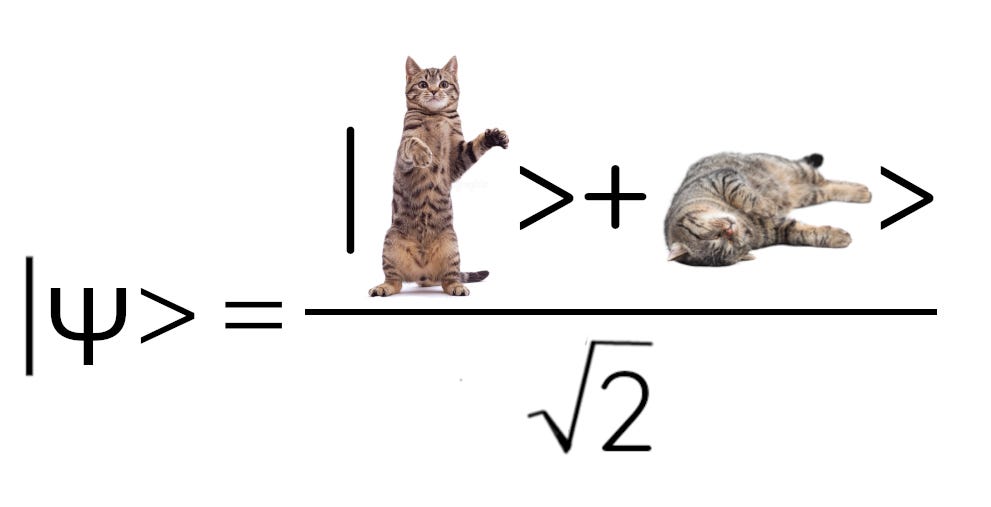
Here is a suggestion for applied quantum physics:
Can we consciously practice being in a state of superposition?
In other words: Can we train ourselves to live a little longer in the potential rather than that? Or perhaps commute between these planes of existence. So at some point the creative person must choose to piss or leave the pot. Something must come out of it, because otherwise ‘creating’ does not make sense. But in order for the right thing to come out as manifested = tangible - and thus measurable - it can perhaps be kept floating above the waters until it is ripe. The artist may want to say: Until it manifests itself. However, it seems a bit self-congratulatory-potty, like when the artistic egghead says: Yes, I don’t know where it came from, it happened by itself, I was just a medium, it was the material that took over.
Well, you were probably there yourself the whole time, so it was not completely ‘by itself’. It’s a very romantic concept of inspired inspiration that comes from above. It was a muse who breathed in my ear, and then I, the genius, came up with a masterpiece. Mwah … don’t you forget that it was hard work? Actually, it’s an ancient concept. Superposition as an expression had not been invented, but the ideas were already there with Plato. They were omnipresent and present at all times as potentials. The philosopher could tap into them by lifting his spirit. The artist interacted with the potential but understandably has difficulty understanding and especially formulating what happened. Result: artistic mumbo jumbo. Shut up and paint your picture and let it speak for itself. A poet trying to explain what the meaning of the poem is is like having to explain a joke. It’s probably not a very good joke.
It doesn’t have to be that grand. Cognitive superposition (a term coined by Robert Greene) should be understood as a state of questioning listening. The ancients called it wondering. It is also present in being curious. It is also an ingredient, an attitude in playing. Playing with the idea of keeping a ready-made solution or a certain and definitive perception floating. Intuition is another way of saying it.
There are plenty of definite (demarcation) and fixed perceptions of reality, the state of things and … people. Psychologist Mel Schwartz has made it a therapeutic method to draw attention to the potential. It can certainly get pretty fluffy if it is not handled in the right way, but people in crisis usually feel stuck. They cannot see possibilities, only obstacles. The ultimate collapse must be depression, where the entire consciousness has shrunk into its own prison cell. Gone is all movement, all hope, all prospects (there are walls without windows), all future, all energy. We can also just say that life is extinguished in a depression, and the depressive cannot just do a von Münchhausen and pull himself and his horse up by the hair. There is graffiti written on all the walls: You can never get out of here! - and where did the door go, by the way?
Here it does not help much to tell the deeply depressed person that they should see their condition as a gift of possibilities. Psychiatrists are very fond of depression, because then they can just prescribe some anti-depressants that depressed can go and eat for the rest of their life. OK, not all psychiatrists probably formulate it like that, but unfortunately it often ends up that way. It has mainly to do with the ‘side effect’ of antidepressants: That they are highly addictive and replace the body’s built-in ability to produce organic antidepressants, endorphins = internal morphines.
At the other end of the scale we have the people who maneuver through life with what the ancients called a bright mind. They have an undisturbed and almost childlike ability to face difficulties with complete confidence. It will all work out, you see. It will work out. They are known for being able to live to be very old, because they have not worn themselves out with worries. They have lived and survived in love for life. One could almost say that they knew the secret behind all faith in God, they were strong in faith - perhaps without even knowing it. Providence (God) will provide for me. It says in the New Testament: Martha, Martha, you are worried about all sorts of things, but only one thing is necessary.
Cell biologist Bruce Lipton defines two possible states for a given cell in the body: fear and love. It is interesting that he attributes these properties to the cell. But we are made up of trillions of cells that - in contrast to human societies - live in unbreakable harmony and … love in a healthy body. They are a society built on love. Fear makes us sick in soul and body. There are those who have always known a lot about this, so they have always introduced appropriate amounts of fear for their purposes.
While we are on the scriptures, it is written elsewhere (1 John 4:18):
There is no fear in love, but perfect love casts out fear; because fear has to do with punishment; but he who fears is not perfected in love.
It is paradoxical and interesting that this obvious life-celebrating statement has survived in what started as a Roman state cult, the main symbol of which is precisely one of this state’s favorite torture and killing instruments. This is because that Christian thing is a motley product of various … shall we say ‘interests’ over time and especially in its formation, and that in addition to the state-political project there are a multitude of these sparks of life. The state could not eradicate the sparks of life, it could only contain them. The state intervened and became a religion.
Love is the superposition, fear has collapsed. Here is a proposal that I know Bruce Lipton would love, because he formulates it himself in a similar way. As an evening prayer, tell all 28-36 trillion cells in your body that you love them and thank them for another day of sustaining and enriching life in the common organism, the local global community, which is your body, which is the vessel you have borrowed while you are here. They do not sleep when you sleep, just as your brain and nervous system are not inactive either.
Cognitive superposition is present in the conversation. Super = above, position = location, where you sit.
In the conversation, an exchange of ideas and potential answers to already existing + questions that have arisen along the way takes place. Could it be so, what do you say? There is nothing wrong with a statement: I mean so and so. It can actually be extremely useful in a provocative way. There is something wrong if you do not ask whether there could be other angles on the matter and are unable to hear another statement to the end. You can still disagree and be convinced that you have the upper hand, but at the very least you have to ask yourself what the conditions for a different opinion might be. Are you or the others best equipped to make a definitive statement, or should you avoid the definitive (superposition) to a greater extent? We can’t stand blabbering relativism, and there is certainly something called the courage of opinions. But we want to have a conversation. We also can’t stand: Yes, I hear what you’re saying… which means I don’t hear a damn thing, you can just babble to yourself, but now you have to hear how things are and keep your mouth shut in the future. You talk down to people while giving them a blanket to talk into.
The one who ‘hears what you say’ without listening does not want a conversation. They do not enter into a conversation to learn, because they already know everything. They think so. But the truly knowledgeable, the wise always enter into a conversation in the hope and expectation of learning something. They know that you can learn something from every person, but they may learn something different and at a different level than the less wise.
And then there are the downright stupid, those who do not understand their own ignorance and believe they know a whole lot. The more educated they are, the more certain they are that they know everything and cannot be wrong. They are stupid up to an academic level. They have neglected and lost the ability to superposition and have collapsed in their own conceit. They are rarely interested in conversation, they want to teach, but they have often lost the humility towards the field of knowledge they believe they master and thus the ability to wonder. They need a shot of Socratic injection of: The more I know, the less I know.
There is a word called potential consciousness.
In other words: There is room for new insights, we can still learn something.
We can also turn the composition around and say potential consciousness.
I can see possibilities in this. I don’t yet know how they can be realized. Let’s talk about it.
That was supposed to be the basic idea of democracy and parliament:
to provide the opportunity to explore the potential through conversation before decisions are made and action is taken.
That basic idea is having a hard time at the moment. The conversation space has become a dirty battlefield.
That was also supposed to be the basic idea of the sciences:
to provide the opportunity to learn more about Great Nature through the very investigation and the potential for knowledge and insight. Isn’t that called natural science? Others call their science human science?
That basic idea is also having a hard time at the moment. The sciences have been invaded by special interests with the expectation of a special outcome.
Reality is cracking these days. Maybe it was not sustainable.
It is experienced as cognitive dissonance. Reality is jarring against … reality.
This is where cognitive superposition comes into play.